
Quality Care Initiatives
Mejorar los resultados de salud para los miembros de Medi-Cal
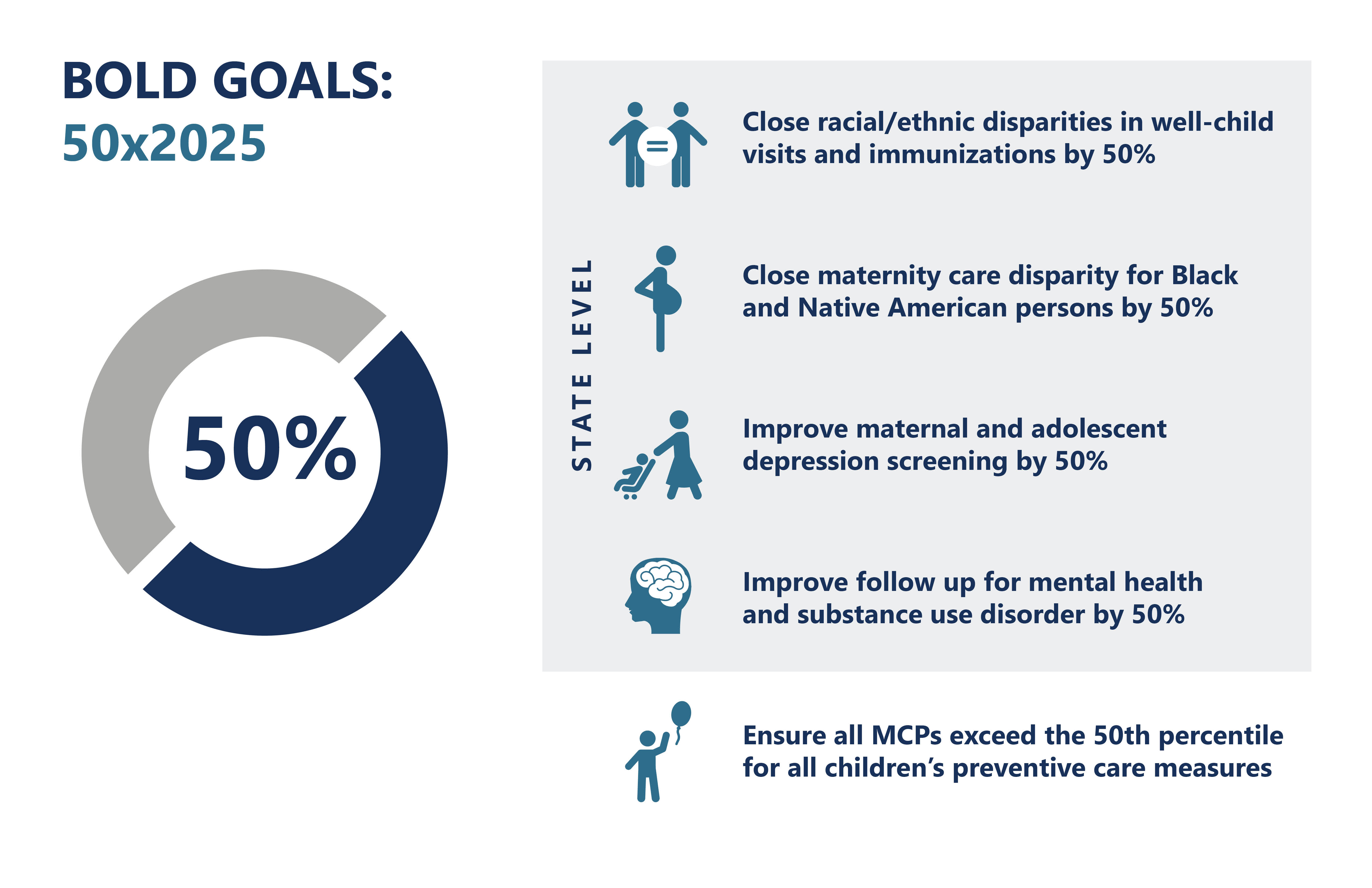
The California Department of Health Care Services (DHCS) is committed to achieving excellence in the quality and equity of care for Medi-Cal members. Through broader efforts focused on Medi-Cal Transformation, as well as through the ambitious 2022 Comprehensive Quality Strategy, DHCS outlined a Population Health Management approach grounded in high-quality primary care as well as the 50×2025 Bold Goals Initiative to improve health care outcomes for children’s preventive health, maternity care and birth equity, and behavioral health integration.
Centrar las voces de los miembros
Un aspecto fundamental de la visión de DHCSen materia de calidad y equidad en salud es la convicción de que los afiliados a Medi-Cal están en el centro del diseño de nuestras políticas y Program.
Hoja de ruta para la equidad en salud: La hoja de ruta para la equidad en salud describe el plan del DHCS para reducir las disparidades en salud mediante la recopilación de datos, la identificación de deficiencias en la atención y la creación de intervenciones específicas para grupos de alto riesgo. Una voltea estatal de escucha recopiló comentarios directos de los afiliados a comunidades que experimentan disparidades para ayudar a definir esta hoja de ruta, que busca fomentar la transparencia y la confianza entre los miembros diversos.
Comité Asesor de Miembros En 2023 , DHCS lanzó el Comité Asesor de Afiliados a Medi-Cal (MMAC, por sus siglas en inglés), un foro dedicado para que los afiliados a Medi-Cal brinden comentarios directos al Director y al equipo directivo ejecutivo de DHCS. El comité está compuesto íntegramente por afiliados a Medi-Cal y cuidadores familiares, lo que garantiza que esté representada una amplia gama de perspectivas.
Mejora de la transparencia y la rendición de cuentas en materia de calidad
Medición de la calidad en salud conductual: Si bien DHCS realizó un seguimiento del desempeño de la calidad de los planes Medi-Cal Managed Care (MCP), a partir de 2022, DHCS también estableció un Conjunto de Responsabilidad de Salud Conductual (BHAS) para medir los resultados de calidad clínica en Health Plan Conductual del condado.
Transparencia mejorada: En los últimos tres años, el DHCS aumentó significativamente la cantidad de informes públicos sobre los resultados de calidad y equidad en los sistemas e iniciativas de entrega para proporcionar una mayor transparencia y empoderar a los socios para que utilicen los datos para impulsar mejoras. Esto incluye, pero no se limita a:
- Panel de control de CalAIM
- Informe trimestral de administración de atención mejorada/apoyo a la comunidad
- Hojas informativas del conjunto de responsabilidad de la atención administrada
- Hojas informativas del conjunto de responsabilidad de la salud conductual
Sanciones y rendición de cuentas: Los MCP que no cumplen con los estándares de calidad pueden enfrentar a planes de acción correctiva, sanciones económicas o incluso la rescisión del contrato en casos graves. Las sanciones cercioran que los planes prioricen la atención de calidad y mejoren la capacidad de servicios cuando sea necesario. En los últimos tres años, DHCS reforzó su política de sanciones por incumplimiento de la normativa tanto para los planes de atención médica gestionada ( MCP) como para Health Planconductual (BHP). Además, DHCS impuso sanciones financieras en 2022, 2023 y 2024 a los MCP que no cumplieron con objetivo del DHCS para resultados de calidad ( percentil 50 nacional).
Apoyo a la mejora de la calidad: DHCS se asoció con MCP en varios esfuerzos de mejora de la calidad para optimizar la atención de los afiliados a Medi-Cal, entre los que se incluyen:
- Participar en la Colaboración de Aprendizaje de Visitas de Bienestar para Infantes y Niños de los Centros de Servicios de Medicare y Medicaid (CMS).
- Crear nuevas colaboraciones regionales para que todos los MCP discutan las barreras regionales, las disparidades y los posibles socios comunitarios.
- Organizar la Conferencia de Calidad y Equidad en Salud del DHCS en 2023 como un foro para que los planes compartan y establezcan redes de estrategias exitosas en la mejora de la calidad y la equidad.
- Launching two new statewide learning collaboratives in 2024, one focused on improving and scaling children’s preventive services and the other focused on behavioral health integration and improved collaboration between MCPs and county behavioral health plans.
Incentivos financieros para impulsar la calidad y la equidad
Quality Withhold and Incentive Program: In 2024, DHCS implemented a Quality Withhold and Incentive (QWI) program. The program incentivizes MCPs to improve performance on quality metrics that align with the DHCS Comprehensive Quality Strategy and Bold Goals by withholding 0.5% of capitated payments, which can be earned back by meeting performance targets for quality, patient satisfaction, and efficiency.
Program de incentivos para la asignación automática: Este Program premia a los profesionales de Medi-Cal con mejor desempeño en ciertos condados (con más de un profesional de Medi-Cal) con un mayor porcentaje de nuevos miembros Medi-Cal (que no eligen activamente un profesional de Medi-Cal). En 2024, DHCS revisó este Programde asignación automática de larga data para centrar exclusivamente en el desempeño de MCP en medidas de calidad seleccionadas, alineadas con su Estrategia Integral de Calidad y sus Objetivos Audaces.
Gasto en atención primaria y modelos de pago alternativos: A partir de 2024, todos los proveedores de atención médica gestionada (MCP, por sus siglas en inglés) deberán informar al DHCS sobre qué porcentaje de su gasto se destina a la atención primaria y cómo emplean modelos de pago alternativos con los proveedores para recompensar la calidad y la equidad. El DHCS colaboró con socios estatales clave, incluidos Covered California y CalPERS, para armonizar estos requisitos contractuales entre los compradores públicos.
Equity and Practice Transformation Payments: In 2024, DHCS launched the Equity and Practice Transformation Payment Program, a $140 million investment in primary care practices to advance health equity and reduce disparities by working on upstream care models, improving quality of care, value-based payment models, and practice transformation.
Invertir en las comunidades
Reinversiones comunitarias de MCP: A partir de 2024, todos los MCP que obtengan ganancias deben reinvertir entre el 7.5 y el 15% de esas ganancias en actividades de reinversión comunitaria informadas y guiadas por las necesidades de la comunidad local.
California Advancing and Innovating Medi-Cal (CalAIM): CalAIM Busca mejorar la atención a los afiliados a Medi-Cal a través de servicios de gestión de atención mejorada y apoyo comunitario , como orientación para la vivienda, comidas adaptadas a las necesidades médicas y viviendas de recuperación, como alternativas a los servicios médicos tradicionales.
Behavioral Health Services: DHCS has significantly increased investments to expand telehealth, integrate behavioral health with primary care, and support the Behavioral Health Continuum Infrastructure Program (BHCIP) to build new treatment and community-based facilities.
- Las iniciativas de BH-CONNECT y Transformación de la Salud Conductual están mejorando el acceso a la atención proporcionando servicios coordinados de divulgación, navegación y participación a personas que necesitan apoyo en salud mental.