
Quality Care Initiatives
Medi-Calメンバーの健康転帰の改善
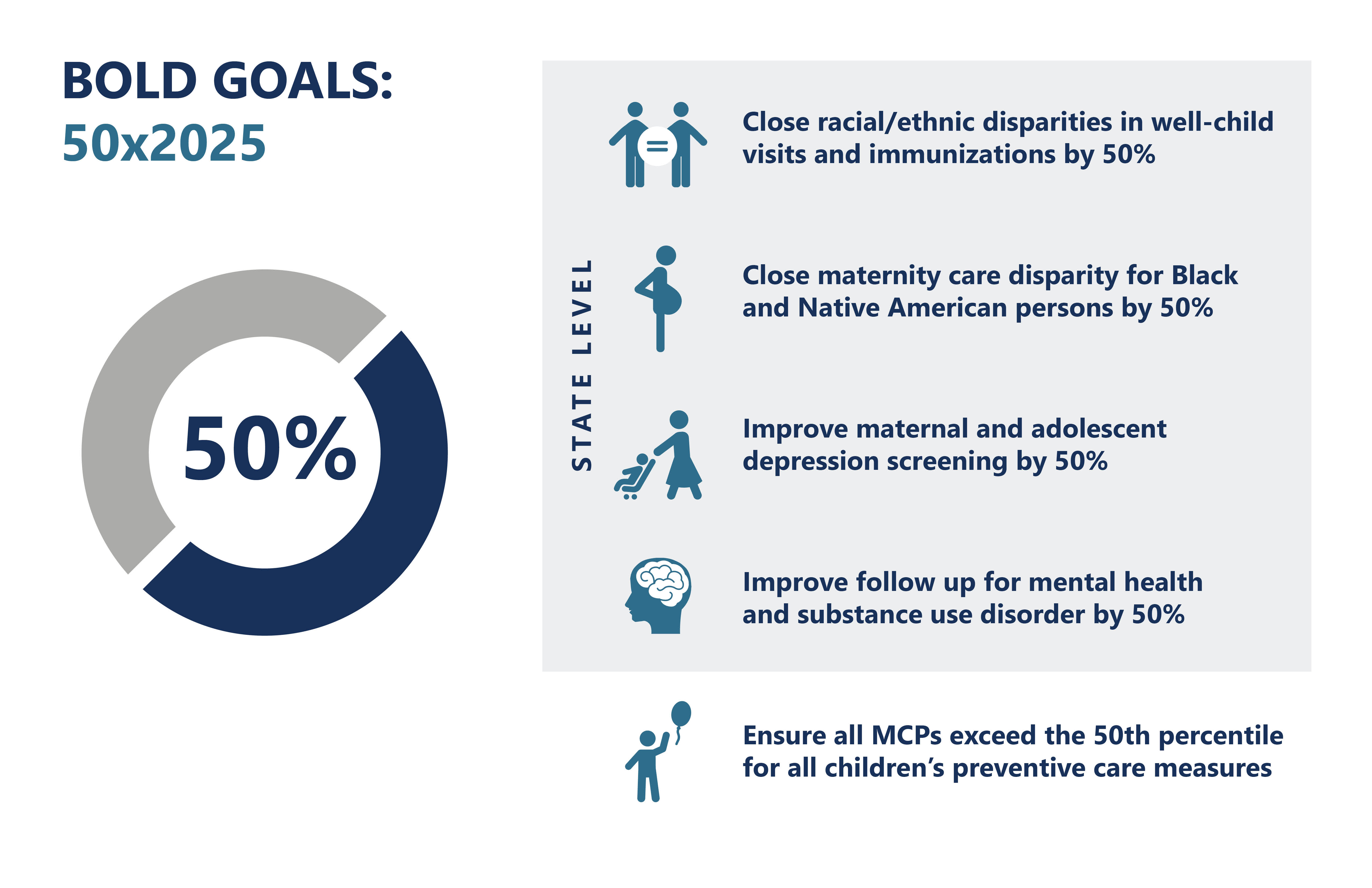
The California Department of Health Care Services (DHCS) is committed to achieving excellence in the quality and equity of care for Medi-Cal members. Through broader efforts focused on Medi-Cal Transformation, as well as through the ambitious 2022 Comprehensive Quality Strategy, DHCS outlined a Population Health Management approach grounded in high-quality primary care as well as the 50×2025 Bold Goals Initiative to improve health care outcomes for children’s preventive health, maternity care and birth equity, and behavioral health integration.
センタリングメンバーの声
Central to DHCS’ vision for quality and health equity is the belief that Medi-Cal members are at the center of our policy design and programs.
Health Equity Roadmap: The Health Equity Roadmap outlines DHCS’ plan to reduce health disparities by collecting data, identifying care gaps, and creating targeted interventions for high-risk groups. A statewide listening tour gathered member feedback directly from communities experiencing disparities to help shape this roadmap, which aims to build transparency and trust among diverse members.
メンバー諮問委員会 : In 2023, DHCS launched the Medi-Cal Member Advisory Committee (MMAC), a dedicated forum for Medi-Cal members to provide direct feedback to DHCS’ Director and executive leadership. The committee is composed entirely of Medi-Cal members and family caregivers, ensuring that a diverse range of perspectives is represented.
品質に対する透明性と説明責任の向上
Quality Measurement in Behavioral Health: While DHCS has long tracked quality performance for Medi-Cal managed care plans (MCP), starting in 2022, DHCS also established a Behavioral Health Accountability Set (BHAS) to measure clinical quality outcomes in county Behavioral Health Plans.
透明性の向上: 過去 3 年間で、DHCS は、透明性を向上させ、パートナーがデータを使用して改善を推進できるように、デリバリー システムとイニシアチブ全体の品質と公平性の結果に関する公開報告の量を大幅に増やしました。 これには以下が含まれますが、これらに限定されません。
- CalAIMダッシュボード
- 四半期ごとの強化されたケア管理/コミュニティサポートレポート
- Managed Care Accountability Set ファクトシート
- 行動健康説明責任セットファクトシート
Sanctions and Accountability: MCPs failing to meet quality standards may face corrective action plans, financial penalties, or even contract termination in severe cases. Sanctions ensure plans prioritize quality care and improve service delivery where necessary. In the last three years, DHCS has strengthened its policy on quality sanctions for both MCPs and Behavioral Health Plans (BHP). Additionally, DHCS levied financial sanctions in 2022, 2023, and 2024 on MCPs that failed to meet DHCS’ target for quality outcomes (national 50th percentile).
Supporting Quality Improvement: DHCS partnered with MCPs on several quality improvement efforts to enhance the care of Medi-Cal members, including:
- メディケア&メディケイドサービスセンター(CMS)の乳児、ウェルチャイルド、訪問学習協力に参加しています。
- すべてのMCPが地域の障壁、格差、および潜在的なコミュニティパートナーについて話し合うための新しい地域協力者を作成します。
- 2023年にDHCS Quality & Health Equity Conferenceを開催する。これは、品質と公平性の向上において成功した戦略を共有し、ネットワークを構築するための計画のためのフォーラムとして開催される。
- Launching two new statewide learning collaboratives in 2024, one focused on improving and scaling children’s preventive services and the other focused on behavioral health integration and improved collaboration between MCPs and county behavioral health plans.
品質と公平性を推進するための金銭的インセンティブ
Quality Withhold and Incentive Program: In 2024, DHCS implemented a Quality Withhold and Incentive (QWI) program. The program incentivizes MCPs to improve performance on quality metrics that align with the DHCS Comprehensive Quality Strategy and Bold Goals by withholding 0.5% of capitated payments, which can be earned back by meeting performance targets for quality, patient satisfaction, and efficiency.
Auto-Assignment Incentive Program: This program rewards higher performing MCPs in certain counties (with more than one MCP) with a greater percentage of new Medi-Cal members (who do not actively choose a MCP). In 2024, DHCS revised this long-standing Auto-Assignment Program to focus solely on MCP performance on select quality measures aligned with its Comprehensive Quality Strategy and Bold Goals.
Primary Care Spending and Alternative Payment Models: Starting in 2024, all MCPs are required to report to DHCS on what percentage of their spending is going toward primary care and how they are using alternative payment models with providers to reward quality and equity. DHCS worked with key state partners, including Covered California and CalPERS, to align these contract requirements across public purchasers.
Equity and Practice Transformation Payments: In 2024, DHCS launched the Equity and Practice Transformation Payment Program, a $140 million investment in primary care practices to advance health equity and reduce disparities by working on upstream care models, improving quality of care, value-based payment models, and practice transformation.
コミュニティへの投資
MCPコミュニティの再投資:2024年以降、利益を上げるすべてのMCPは、その利益の7.5〜15%を、地域コミュニティのニーズに基づいて情報を提供し、指導するコミュニティ再投資活動に再投資する必要があります。
California Advancing and Innovating Medi-Cal (CalAIM): CalAIM seeks to improve care for Medi-Cal members through Enhanced Care Management and Community Supports services, like housing navigation, medically tailored meals, and recovery housing, as alternatives to traditional medical services.
Behavioral Health Services: DHCS has significantly increased investments to expand telehealth, integrate behavioral health with primary care, and support the Behavioral Health Continuum Infrastructure Program (BHCIP) to build new treatment and community-based facilities.
- BH-CONNECTおよび行動健康変革イニシアチブは、行動健康支援を必要とする個人に対し、連携したアウトリーチ、ナビゲーション、およびエンゲージメントサービスを提供することにより、ケアへのアクセスを向上させています。